
Restructuring Back Office Finance Leads to $1.8M Annualized Net Benefit for Property Management Leader

A North American Leader in Property Management 

$1.8M
Annualized Net
Benefit
2.4x
Project Return on
Investment

Context

Rapid Growth Exposed Critical Operational Gaps 

Our client had experienced a period of substantial growth, driven by multiple acquisitions that increased their team size by 30% in just 18 months. This rapid expansion was a strategic success, however, it exposed significant inefficiencies within their back-office financial operations. Without a scalable foundation, the influx of new properties, processes, and people strained their existing systems and workflows. The consequences led to: declining quality in client deliverables, rising employee burnout and turnover, and a direct negative impact on client retention.

What We Discovered

Data-Driven Insights into Operational Strain 

We conducted a comprehensive 7-week diagnostic study to pinpoint the root causes of the challenges they were experiencing. Following 80 staff interviews and the mapping of 70 distinct processes, we captured and analyzed 275 unique pain points. This deep dive revealed that the issues were not isolated but interconnected, stemming from a lack of organizational clarity and process discipline as outlined: 


  • Role Ambiguity: A lack of clearly defined roles and responsibilities created confusion, redundant work, and a void in accountability across the Client Accounting division. 
  • Unbalanced Workloads: Our analysis showed that property portfolios were not allocated based on complexity. This resulted in some Financial Analysts being significantly overworked while others were underutilized. The effective labor cost per invoice for Accounts Receivable staff varied dramatically, with some coordinators costing nearly three times as much as others to process an invoice. 
  • Widespread Inefficiencies: Staff spent a disproportionate amount of time on low-value, administrative tasks. Financial Analysts dedicated 26% of their day to answering emails, while Accounts Receivable coordinators spent 37% of their time on the same task, diverting focus from critical financial analysis and client support. 
  • Misaligned Pricing Strategy: We found only a weak correlation (+0.28) between a property’s complexity and its management fee. This meant the company was often undervaluing its services for the most demanding and time-consuming properties. 

Our Approach

A Holistic Program for Sustainable Change 

Based on our findings, we developed and executed an 18-week implementation program centered on eight integrated workstreams. This strategic initiative was designed to fix immediate problems and build a robust and scalable foundation for the Client Accounting division, enabling future growth without sacrificing quality or efficiency.  It was comprised of the following solutions: 

  • Clarified Roles & Responsibilities: We redesigned the organizational structure, creating clear job descriptions and a matrix of accountabilities. This eliminated ambiguity and empowered team members by defining ownership of key processes. 
  • Consolidated Ticket System: We implemented the Zendesk Customer Service software to over 200 users, centralizing all AP, AR, Banking, Customer Support and Financial Management tickets into a single platform. This provided complete visibility into request volumes and performance, replacing scattered email chains with a streamlined, trackable single source of truth system with real time metrics. 
  • Deployment of a Capacity Planning Tool: We built and implemented a dynamic tool to assess employee workload based on property complexity and volume. This enabled management to reallocate over 100 properties, achieving a more balanced and equitable distribution of work. 
  • Redefined Future State Processes & SLAs: We re-engineered and documented 37 core financial workflows, embedding 72 new Service Level Agreements (SLAs) to standardize procedures and establish clear expectations for performance and delivery timelines. 
  • Automated Quality Control System: We replaced a cumbersome, 150-item manual Excel checklist with a streamlined 28-question Microsoft PowerApp. This automated the monthly quality review process for financial packages and integrated with Power BI for real-time performance tracking. 
  • Enhanced Client Communication: To improve reporting quality and client satisfaction, we created a standardized Variance Analysis Template and developed scenario-based playbooks for handling client escalations. 
  • Organizational Restructuring Implemented: We implemented a comprehensive organizational redesign, developing an interactive migration plan that addressed headcount impacts, financial implications, and a comprehensive communication strategy to ensure smooth transitions. 
  • Managed Change/Adoption Proactively: We facilitated the successful adoption of these new tools and processes through a structured change management program that included user acceptance testing, pilot programs, and consistent, clear communication. 

Value Created

Measurable Improvements in Efficiency, Quality, and Financial Performance 

he implementation of solutions successfully transformed their Client Accounting division into a more efficient, accountable, and scalable operation. By addressing the foundational issues of role ambiguity, process and technology inefficiencies and supporting ‘change’ adoption, we delivered significant and lasting value across the organization leading to: 
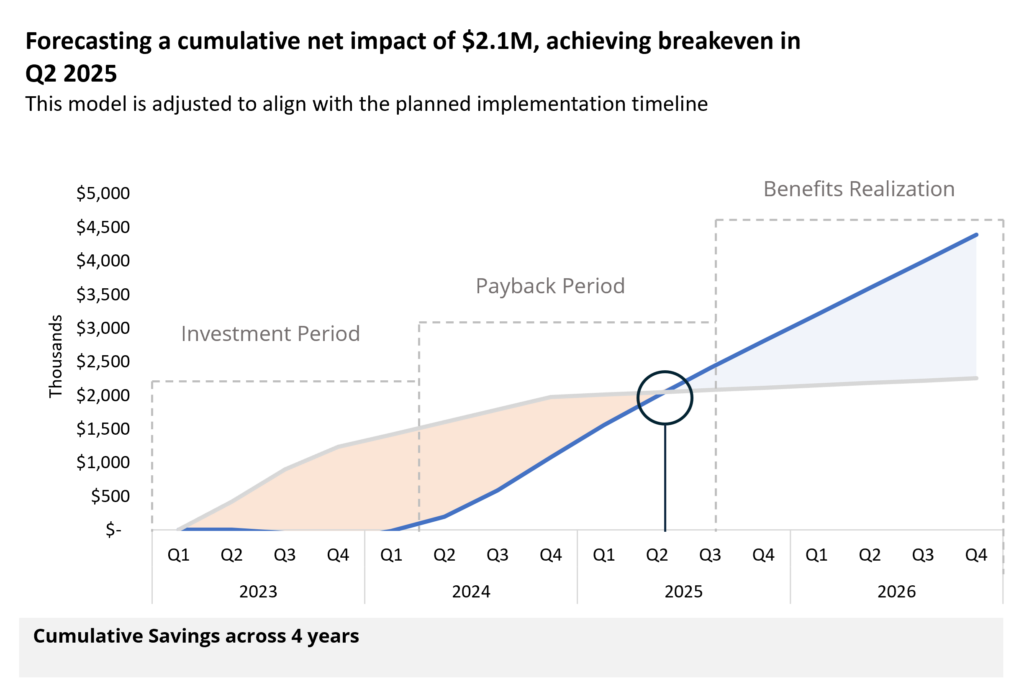
 

  • $1.8M in Annualized Net Benefits: The program delivered substantial cost savings and efficiency gains, with a projected cumulative net impact of $2.1M over four years. 
  • A 2.4x Return on Investment: The financial benefits far outweighed the costs, demonstrating a clear and compelling business case for the transformation. 
  • A Foundation for Scalability: By redesigning 37 core processes and clarifying roles, our client can now absorb future growth without the operational friction that previously hindered performance. 
  • Strengthened Quality and Accountability: The new automated quality control app and Zendesk KPI dashboards provide management with unprecedented visibility into performance, enabling proactive issue resolution and continuous improvement. 
  • Improved Employee Experience: Balancing workloads through the new capacity planning model and reducing manual, repetitive tasks has led to a more manageable and rewarding work environment, positioning our client to better retain top talent. 
Forecasting a cumulative net impact

Join our list of satisfied clients

The Poirier Group | Restructuring Back Office Finance Leads to $1.8M Annualized Net Benefit for Property Management Leader

Let's Chat